Review


apmap silencer select sirna  (Thermo Fisher)


Bioz Verified Symbol Thermo Fisher is a verified supplier
Bioz Manufacturer Symbol Thermo Fisher manufactures this product  

  • Logo
  • About
  • News
  • Press Release
  • Team
  • Advisors
  • Partners
  • Contact
  • Bioz Stars
  • Bioz vStars
  • 90

    Structured Review

    Thermo Fisher apmap silencer select sirna
    Apmap Silencer Select Sirna, supplied by Thermo Fisher, used in various techniques. Bioz Stars score: 90/100, based on 1 PubMed citations. ZERO BIAS - scores, article reviews, protocol conditions and more
    https://www.bioz.com/result/apmap silencer select sirna/product/Thermo Fisher
    Average 90 stars, based on 1 article reviews
    apmap silencer select sirna - by Bioz Stars, 2026-03
    90/100 stars
    Images


    Similar Products

    90
    Thermo Fisher apmap silencer select sirna
    Apmap Silencer Select Sirna, supplied by Thermo Fisher, used in various techniques. Bioz Stars score: 90/100, based on 1 PubMed citations. ZERO BIAS - scores, article reviews, protocol conditions and more
    https://www.bioz.com/result/apmap silencer select sirna/product/Thermo Fisher
    Average 90 stars, based on 1 article reviews
    apmap silencer select sirna - by Bioz Stars, 2026-03
    90/100 stars
      Buy from Supplier

    90
    Thermo Fisher apmap sirna
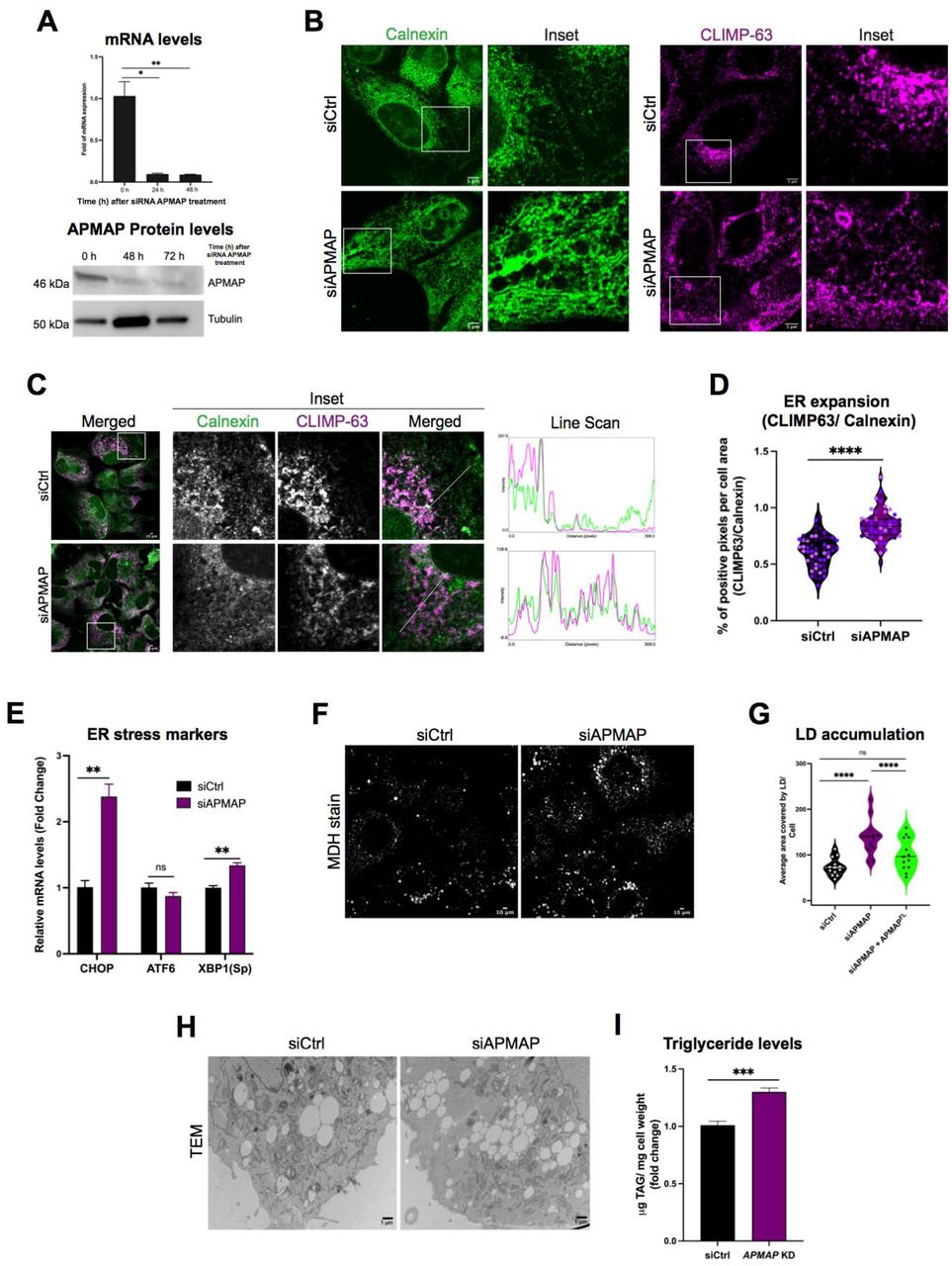
    A. (Top) qPCR of <t>APMAP</t> mRNA levels and (Bottom) western blot of APMAP protein levels validating efficient <t>siRNA-mediated</t> APMAP (siAPMAP) knockdown (N=3; **P<0.0021; *P<0.0322; Two tailed unpaired t-test) B. Airyscan confocal micrographs of Huh7 cells treated with scrambled (siCtrl) and siAPMAP. Cells were IF stained using α-Calnexin (green) or α-CLIMP63 (magenta). Scale Bar = 5 μm C. Confocal micrographs of siCtrl and siAPMAP treated Huh7 cells, co-IF stained with α-Calnexin (green) and α-CLIMP63 (magenta). Scale bar = 10 μm. Line scans (straight line with 5 pixel width) representing spatial distribution of calnexin (green) and CLIMP63 (magenta) were produced using “plot profile’ function in ImageJ D. Violin scatter dot plots demonstrating ER membrane expansion in siCtrl and siAPMAP treated Huh7 cells. The plot depicts the ratio of the percent area of CLIMP-63 positive pixels of CLIMP63 over percent positive pixels of Calnexin per cell. Individual data points from more than 50 cells from three sets of independent experiments (**** P<0.0001; Ordinary one-way ANOVA) E. qPCR quantification of mRNA levels of ER stress marker genes (CHOP, ATF6 and spXBP1) from siCtrl and siAPMAP treated cells. N=3, **P<0.0021; Multiple unpaired t-tests Holm-Šídák method with alpha = 0.05 F. Confocal micrographs showing LDs in siCtrl and siAPMAP treated Huh7 cells. LDs were visualized by MDH (gray). Scale bar= 10 μm G. Violin plot representing quantified average area covered by LDs per cell. Total LD area was derived from more than 10 fields of view, each consisting of 10-15 cells and from three sets of experiments (****P<0.0001; one-way ANOVA with Sidak’s multiple comparisons; α = 0.05) H. TEM micrographs of siCtrl and siAPMAP treated U2OS cells followed by a 16h OA treatment to visualize LD morphology. Scale bar= 1 μm I. Quantification of TAG levels in siCtrl and siAPMAP treated cells, using TLC (in micrograms). Data represent mean ± SEM normalized to cell pellet weight; N = 3; ***P<0.0002; Two tailed unpaired t-test
    Apmap Sirna, supplied by Thermo Fisher, used in various techniques. Bioz Stars score: 90/100, based on 1 PubMed citations. ZERO BIAS - scores, article reviews, protocol conditions and more
    https://www.bioz.com/result/apmap sirna/product/Thermo Fisher
    Average 90 stars, based on 1 article reviews
    apmap sirna - by Bioz Stars, 2026-03
    90/100 stars
      Buy from Supplier

    90
    Qiagen apmap specific sirna
    (A) SVG-A cells preincubated with <t>anti-APMAP</t> antisera and then infected with JCPyV exhibit reduced infection compared to cells preincubated with isotype control antibody. Post infection, cells were fixed and stained with anti-VP1 antibody (green) and nuclei were counterstained with DAPI (blue). (B) Quantification of VP1(+) nuclei. Experiments were performed three times in triplicate. Error bars represent SD. *p<0.05
    Apmap Specific Sirna, supplied by Qiagen, used in various techniques. Bioz Stars score: 90/100, based on 1 PubMed citations. ZERO BIAS - scores, article reviews, protocol conditions and more
    https://www.bioz.com/result/apmap specific sirna/product/Qiagen
    Average 90 stars, based on 1 article reviews
    apmap specific sirna - by Bioz Stars, 2026-03
    90/100 stars
      Buy from Supplier

    90
    Qiagen apmap sirna flexitube gene solution #gs57136
    (A) SVG-A cells preincubated with <t>anti-APMAP</t> antisera and then infected with JCPyV exhibit reduced infection compared to cells preincubated with isotype control antibody. Post infection, cells were fixed and stained with anti-VP1 antibody (green) and nuclei were counterstained with DAPI (blue). (B) Quantification of VP1(+) nuclei. Experiments were performed three times in triplicate. Error bars represent SD. *p<0.05
    Apmap Sirna Flexitube Gene Solution #Gs57136, supplied by Qiagen, used in various techniques. Bioz Stars score: 90/100, based on 1 PubMed citations. ZERO BIAS - scores, article reviews, protocol conditions and more
    https://www.bioz.com/result/apmap sirna flexitube gene solution #gs57136/product/Qiagen
    Average 90 stars, based on 1 article reviews
    apmap sirna flexitube gene solution #gs57136 - by Bioz Stars, 2026-03
    90/100 stars
      Buy from Supplier

    92
    Santa Cruz Biotechnology pparγ
    (A) SVG-A cells preincubated with <t>anti-APMAP</t> antisera and then infected with JCPyV exhibit reduced infection compared to cells preincubated with isotype control antibody. Post infection, cells were fixed and stained with anti-VP1 antibody (green) and nuclei were counterstained with DAPI (blue). (B) Quantification of VP1(+) nuclei. Experiments were performed three times in triplicate. Error bars represent SD. *p<0.05
    Pparγ, supplied by Santa Cruz Biotechnology, used in various techniques. Bioz Stars score: 92/100, based on 1 PubMed citations. ZERO BIAS - scores, article reviews, protocol conditions and more
    https://www.bioz.com/result/pparγ/product/Santa Cruz Biotechnology
    Average 92 stars, based on 1 article reviews
    pparγ - by Bioz Stars, 2026-03
    92/100 stars
      Buy from Supplier

    90
    Shanghai GenePharma apmap sirna
    (A) SVG-A cells preincubated with <t>anti-APMAP</t> antisera and then infected with JCPyV exhibit reduced infection compared to cells preincubated with isotype control antibody. Post infection, cells were fixed and stained with anti-VP1 antibody (green) and nuclei were counterstained with DAPI (blue). (B) Quantification of VP1(+) nuclei. Experiments were performed three times in triplicate. Error bars represent SD. *p<0.05
    Apmap Sirna, supplied by Shanghai GenePharma, used in various techniques. Bioz Stars score: 90/100, based on 1 PubMed citations. ZERO BIAS - scores, article reviews, protocol conditions and more
    https://www.bioz.com/result/apmap sirna/product/Shanghai GenePharma
    Average 90 stars, based on 1 article reviews
    apmap sirna - by Bioz Stars, 2026-03
    90/100 stars
      Buy from Supplier

    90
    Qiagen apmap sirna
    Identification of endogenous modulators of γ-secretase and Aβ production. ( A ) Analysis by LC-MS/MS of the protein components of the highly purified γ-secretase complex. ( B and C <t>)</t> <t>siRNA</t> knockdown of TSPAN6, RTN4 and <t>APMAP</t> affects APP-CTFs in HeLa cells (B) and HEK cells overexpressing APP bearing the Swedish mutation that causes early-onset familial Alzheimer's disease (HEK-APPSwe; C). Biological duplicates are shown for each siRNA condition. ( D ) Correlation between APP-CTFs levels and Aβ40 production in HEK-APPSwe cells with reduced TSPAN6, RTN4 and APMAP expression. APP-CTFs levels were estimated by densitometric analysis, while Aβ40 levels were quantified by ELISA. Student's t -test was applied for statistical analysis; significance is shown as mean ± SD, * P < 0.05; ** P < 0.01; Aβ40: n = 6/group; APP-CTFs: n = 4/Scramble, TSPAN6and APMAP groups; n = 3/RTN4 group. β-Actin served as a protein loading control. mAPP-FL and iAPP-FL: mature and immature APP full-length.
    Apmap Sirna, supplied by Qiagen, used in various techniques. Bioz Stars score: 90/100, based on 1 PubMed citations. ZERO BIAS - scores, article reviews, protocol conditions and more
    https://www.bioz.com/result/apmap sirna/product/Qiagen
    Average 90 stars, based on 1 article reviews
    apmap sirna - by Bioz Stars, 2026-03
    90/100 stars
      Buy from Supplier

    Image Search Results


    A. (Top) qPCR of APMAP mRNA levels and (Bottom) western blot of APMAP protein levels validating efficient siRNA-mediated APMAP (siAPMAP) knockdown (N=3; **P<0.0021; *P<0.0322; Two tailed unpaired t-test) B. Airyscan confocal micrographs of Huh7 cells treated with scrambled (siCtrl) and siAPMAP. Cells were IF stained using α-Calnexin (green) or α-CLIMP63 (magenta). Scale Bar = 5 μm C. Confocal micrographs of siCtrl and siAPMAP treated Huh7 cells, co-IF stained with α-Calnexin (green) and α-CLIMP63 (magenta). Scale bar = 10 μm. Line scans (straight line with 5 pixel width) representing spatial distribution of calnexin (green) and CLIMP63 (magenta) were produced using “plot profile’ function in ImageJ D. Violin scatter dot plots demonstrating ER membrane expansion in siCtrl and siAPMAP treated Huh7 cells. The plot depicts the ratio of the percent area of CLIMP-63 positive pixels of CLIMP63 over percent positive pixels of Calnexin per cell. Individual data points from more than 50 cells from three sets of independent experiments (**** P<0.0001; Ordinary one-way ANOVA) E. qPCR quantification of mRNA levels of ER stress marker genes (CHOP, ATF6 and spXBP1) from siCtrl and siAPMAP treated cells. N=3, **P<0.0021; Multiple unpaired t-tests Holm-Šídák method with alpha = 0.05 F. Confocal micrographs showing LDs in siCtrl and siAPMAP treated Huh7 cells. LDs were visualized by MDH (gray). Scale bar= 10 μm G. Violin plot representing quantified average area covered by LDs per cell. Total LD area was derived from more than 10 fields of view, each consisting of 10-15 cells and from three sets of experiments (****P<0.0001; one-way ANOVA with Sidak’s multiple comparisons; α = 0.05) H. TEM micrographs of siCtrl and siAPMAP treated U2OS cells followed by a 16h OA treatment to visualize LD morphology. Scale bar= 1 μm I. Quantification of TAG levels in siCtrl and siAPMAP treated cells, using TLC (in micrograms). Data represent mean ± SEM normalized to cell pellet weight; N = 3; ***P<0.0002; Two tailed unpaired t-test

    Journal: bioRxiv

    Article Title: Paraoxonase-like APMAP maintains endoplasmic reticulum-associated lipid and lipoprotein homeostasis

    doi: 10.1101/2024.01.26.577049

    Figure Lengend Snippet: A. (Top) qPCR of APMAP mRNA levels and (Bottom) western blot of APMAP protein levels validating efficient siRNA-mediated APMAP (siAPMAP) knockdown (N=3; **P<0.0021; *P<0.0322; Two tailed unpaired t-test) B. Airyscan confocal micrographs of Huh7 cells treated with scrambled (siCtrl) and siAPMAP. Cells were IF stained using α-Calnexin (green) or α-CLIMP63 (magenta). Scale Bar = 5 μm C. Confocal micrographs of siCtrl and siAPMAP treated Huh7 cells, co-IF stained with α-Calnexin (green) and α-CLIMP63 (magenta). Scale bar = 10 μm. Line scans (straight line with 5 pixel width) representing spatial distribution of calnexin (green) and CLIMP63 (magenta) were produced using “plot profile’ function in ImageJ D. Violin scatter dot plots demonstrating ER membrane expansion in siCtrl and siAPMAP treated Huh7 cells. The plot depicts the ratio of the percent area of CLIMP-63 positive pixels of CLIMP63 over percent positive pixels of Calnexin per cell. Individual data points from more than 50 cells from three sets of independent experiments (**** P<0.0001; Ordinary one-way ANOVA) E. qPCR quantification of mRNA levels of ER stress marker genes (CHOP, ATF6 and spXBP1) from siCtrl and siAPMAP treated cells. N=3, **P<0.0021; Multiple unpaired t-tests Holm-Šídák method with alpha = 0.05 F. Confocal micrographs showing LDs in siCtrl and siAPMAP treated Huh7 cells. LDs were visualized by MDH (gray). Scale bar= 10 μm G. Violin plot representing quantified average area covered by LDs per cell. Total LD area was derived from more than 10 fields of view, each consisting of 10-15 cells and from three sets of experiments (****P<0.0001; one-way ANOVA with Sidak’s multiple comparisons; α = 0.05) H. TEM micrographs of siCtrl and siAPMAP treated U2OS cells followed by a 16h OA treatment to visualize LD morphology. Scale bar= 1 μm I. Quantification of TAG levels in siCtrl and siAPMAP treated cells, using TLC (in micrograms). Data represent mean ± SEM normalized to cell pellet weight; N = 3; ***P<0.0002; Two tailed unpaired t-test

    Article Snippet: Cells were transfected with scrambled siRNA (Silencer Select negative control, Thermo Fisher 4390843 or Silencer Negative Control 1, Thermo Fisher AM4611) and APMAP siRNA (Silencer Select siRNA, Thermo Fisher s32757) with a final concentration of 10 nM, using Lipofectamine RNAiMAX reagent (Thermo Fisher 13778075) for 48 h. Cells were transfected with pre-incubated siRNA with a final concentration of 10 nM siRNA (3.75 μl of lipofectamine RNAiMAX in 125 μls of Opti-MEM, Gibco 31985-070) for 48 h. Cells were transfected again the following day with 10 nM siRNA for a 72 h total knockdown time.

    Techniques: Western Blot, Two Tailed Test, Staining, Produced, Membrane, Marker, Derivative Assay

    A. Confocal micrographs of U2OS cells treated with siCtrl, siAPMAP and siAPMAP rescued with siRNA resistant APMAP FL overexpression, incubated with and without TBHP. Cells were stained with BODIPY-C11 to determine the level of oxidation under each condition; Red, reduced form of BODIPY-C11 and Green, oxidized form of BODIPY-C11 B. Line scan (line width of 100 pixels) quantification of 510 nm shift (green; oxidized BODIPY-C11) on the cell surface of siAPMAP treated U2OS cells compared to siCtrl cells C. Fluorescent integrated density of 510 nm shift (green; oxidized) in BODIPY-C11 at the cell periphery was quantified using ImageJ. The statistical significance was assessed by one-way ANOVA with Sidak’s multiple comparison (p=0.0149; 30 cells per condition; N=3). Means +/- SDs shown D. Confocal micrographs of larval FB tissue sections from control ( Dcg-Gal4 line) and dAPMAP-RNAi line with FB-specific RNAi depletion, stained with BODIPY-C11. Images represent oxidized (green) BODIPY-C11 staining and reduced (red) BODIPY-C11 staining in RNAi depleted tissue compared to control tissues. Scale bar= 10 μm E. Quantification of oxidized over reduced BODIPY-C11 in of larval FB tissues represented in was quantified using ImageJ. ***P<0.0021; Two-way ANOVA with Sidak’s multiple comparison F. Live confocal micrographs of siCtrl and siAPMAP treated Huh7 cells expressed with ROS biosensor HyPer-ER lumen (denoted HyPER here) construct showing 405 and 488 stimulated fluorescence for 6 mins after treatment with 2mM H 2 O 2 G. Line graph of fluorescence emission of 488/405 ratio shift measured using HyPer-ERlum in siCtrl and siAPMAP treated Huh7 cells incubated with 2 mM H 2 O 2 . Rescue experiments using different APMAP fragments also shown. Line graphs represent mean of +/- 95% confidence interval (CI) of fluorescence shift. CIs of all conditions shown in dotted lines H. Quantification of oxidized over reduced BODIPY-C11 from WT and APMAP FL overexpressed U2OS cells at 0 and 2 h after 2 mM H 2 O 2 treatment, were quantified using ImageJ. The statistical significance was assessed by Ordinary one-way ANOVA with Sidak’s multiple comparison (****P<0.0001; n = 30; N=3). Means +/- SEMs shown I. Violin scatter dot plots demonstrating rescue experiment of ER membrane expansion in siAPMAP Huh7 cells by treating with 200uM NAC for 16 h. The plot depicts the ratio of the percent area of CLIMP-63 positive pixels over percent positive pixels of Calnexin per cell. Individual data points from more than 50 cells from three sets of independent experiments (**** P<0.0001; ***P<0.0002; Ordinary one-way ANOVA with Sidak’s multiple comparisons; α = 0.05) J. Rescue experiment of LD morphology in siAPMAP Huh7 cells treated using ROS inhibitor NAC for 16 h. Violin scatter dot plots represent average area covered by LDs per cell in a given ROI. Total LD area was derived from more than 10 ROI, each consisting of 10-15 cells from three sets of experiments (N =3, ****p<0.0001; ***P<0.0002; one-way ANOVA with Sidak’s multiple comparison) K. Violin scatter dot plots demonstrating rescuing of intracellular ApoB levels in siAPMAP Huh7 cells through NAC treatment for 16 h. Each dot depicts the percent area of ApoB positive pixels per cell. (n>50; N=3; **** P<0.0001; Ordinary one-way ANOVA with Sidak’s multiple comparisons; α = 0.05)

    Journal: bioRxiv

    Article Title: Paraoxonase-like APMAP maintains endoplasmic reticulum-associated lipid and lipoprotein homeostasis

    doi: 10.1101/2024.01.26.577049

    Figure Lengend Snippet: A. Confocal micrographs of U2OS cells treated with siCtrl, siAPMAP and siAPMAP rescued with siRNA resistant APMAP FL overexpression, incubated with and without TBHP. Cells were stained with BODIPY-C11 to determine the level of oxidation under each condition; Red, reduced form of BODIPY-C11 and Green, oxidized form of BODIPY-C11 B. Line scan (line width of 100 pixels) quantification of 510 nm shift (green; oxidized BODIPY-C11) on the cell surface of siAPMAP treated U2OS cells compared to siCtrl cells C. Fluorescent integrated density of 510 nm shift (green; oxidized) in BODIPY-C11 at the cell periphery was quantified using ImageJ. The statistical significance was assessed by one-way ANOVA with Sidak’s multiple comparison (p=0.0149; 30 cells per condition; N=3). Means +/- SDs shown D. Confocal micrographs of larval FB tissue sections from control ( Dcg-Gal4 line) and dAPMAP-RNAi line with FB-specific RNAi depletion, stained with BODIPY-C11. Images represent oxidized (green) BODIPY-C11 staining and reduced (red) BODIPY-C11 staining in RNAi depleted tissue compared to control tissues. Scale bar= 10 μm E. Quantification of oxidized over reduced BODIPY-C11 in of larval FB tissues represented in was quantified using ImageJ. ***P<0.0021; Two-way ANOVA with Sidak’s multiple comparison F. Live confocal micrographs of siCtrl and siAPMAP treated Huh7 cells expressed with ROS biosensor HyPer-ER lumen (denoted HyPER here) construct showing 405 and 488 stimulated fluorescence for 6 mins after treatment with 2mM H 2 O 2 G. Line graph of fluorescence emission of 488/405 ratio shift measured using HyPer-ERlum in siCtrl and siAPMAP treated Huh7 cells incubated with 2 mM H 2 O 2 . Rescue experiments using different APMAP fragments also shown. Line graphs represent mean of +/- 95% confidence interval (CI) of fluorescence shift. CIs of all conditions shown in dotted lines H. Quantification of oxidized over reduced BODIPY-C11 from WT and APMAP FL overexpressed U2OS cells at 0 and 2 h after 2 mM H 2 O 2 treatment, were quantified using ImageJ. The statistical significance was assessed by Ordinary one-way ANOVA with Sidak’s multiple comparison (****P<0.0001; n = 30; N=3). Means +/- SEMs shown I. Violin scatter dot plots demonstrating rescue experiment of ER membrane expansion in siAPMAP Huh7 cells by treating with 200uM NAC for 16 h. The plot depicts the ratio of the percent area of CLIMP-63 positive pixels over percent positive pixels of Calnexin per cell. Individual data points from more than 50 cells from three sets of independent experiments (**** P<0.0001; ***P<0.0002; Ordinary one-way ANOVA with Sidak’s multiple comparisons; α = 0.05) J. Rescue experiment of LD morphology in siAPMAP Huh7 cells treated using ROS inhibitor NAC for 16 h. Violin scatter dot plots represent average area covered by LDs per cell in a given ROI. Total LD area was derived from more than 10 ROI, each consisting of 10-15 cells from three sets of experiments (N =3, ****p<0.0001; ***P<0.0002; one-way ANOVA with Sidak’s multiple comparison) K. Violin scatter dot plots demonstrating rescuing of intracellular ApoB levels in siAPMAP Huh7 cells through NAC treatment for 16 h. Each dot depicts the percent area of ApoB positive pixels per cell. (n>50; N=3; **** P<0.0001; Ordinary one-way ANOVA with Sidak’s multiple comparisons; α = 0.05)

    Article Snippet: Cells were transfected with scrambled siRNA (Silencer Select negative control, Thermo Fisher 4390843 or Silencer Negative Control 1, Thermo Fisher AM4611) and APMAP siRNA (Silencer Select siRNA, Thermo Fisher s32757) with a final concentration of 10 nM, using Lipofectamine RNAiMAX reagent (Thermo Fisher 13778075) for 48 h. Cells were transfected with pre-incubated siRNA with a final concentration of 10 nM siRNA (3.75 μl of lipofectamine RNAiMAX in 125 μls of Opti-MEM, Gibco 31985-070) for 48 h. Cells were transfected again the following day with 10 nM siRNA for a 72 h total knockdown time.

    Techniques: Over Expression, Incubation, Staining, Comparison, Construct, Fluorescence, Membrane, Derivative Assay

    (A) SVG-A cells preincubated with anti-APMAP antisera and then infected with JCPyV exhibit reduced infection compared to cells preincubated with isotype control antibody. Post infection, cells were fixed and stained with anti-VP1 antibody (green) and nuclei were counterstained with DAPI (blue). (B) Quantification of VP1(+) nuclei. Experiments were performed three times in triplicate. Error bars represent SD. *p<0.05

    Journal: Virology

    Article Title: Adipocyte Plasma Membrane Protein (APMAP) promotes JC Virus (JCPyV) Infection in Human Glial Cells

    doi: 10.1016/j.virol.2020.06.002

    Figure Lengend Snippet: (A) SVG-A cells preincubated with anti-APMAP antisera and then infected with JCPyV exhibit reduced infection compared to cells preincubated with isotype control antibody. Post infection, cells were fixed and stained with anti-VP1 antibody (green) and nuclei were counterstained with DAPI (blue). (B) Quantification of VP1(+) nuclei. Experiments were performed three times in triplicate. Error bars represent SD. *p<0.05

    Article Snippet: APMAP specific siRNA and control siRNA were obtained from Qiagen (APMAP siRNA Flexitube Gene Solution #GS57136; APMAP 1: CAAGGGACTATTTGAAGTAAA; APMAP 2: CTGGGTGGGCATGTCGACCAT; APMAP 3: CATGCTGGATTTCTTATCTGA; APMAP 4: TTCACCGATTCTAGCAGCAAA) and Flexitube All Stars Negative Control siRNA # SI03650318.

    Techniques: Infection, Control, Staining

    (A) SVG-A cells were untreated or treated with control nontargeting siRNA (NegC) or one of four different APMAP-specific siRNAs for 72 hours and then infected with JCPyV. Post-infection, cells were fixed and stained for VP1 and counterstained with DAPI, and VP1(+) nuclei quantified. (B) siRNA knockdown of APMAP decreases APMAP protein in SVG-A cells. (C) Quantification of western blot band intensity using Odyssey software. The results represent the average of two independent experiments performed in triplicate. Error bars represent SD. *p<0.05

    Journal: Virology

    Article Title: Adipocyte Plasma Membrane Protein (APMAP) promotes JC Virus (JCPyV) Infection in Human Glial Cells

    doi: 10.1016/j.virol.2020.06.002

    Figure Lengend Snippet: (A) SVG-A cells were untreated or treated with control nontargeting siRNA (NegC) or one of four different APMAP-specific siRNAs for 72 hours and then infected with JCPyV. Post-infection, cells were fixed and stained for VP1 and counterstained with DAPI, and VP1(+) nuclei quantified. (B) siRNA knockdown of APMAP decreases APMAP protein in SVG-A cells. (C) Quantification of western blot band intensity using Odyssey software. The results represent the average of two independent experiments performed in triplicate. Error bars represent SD. *p<0.05

    Article Snippet: APMAP specific siRNA and control siRNA were obtained from Qiagen (APMAP siRNA Flexitube Gene Solution #GS57136; APMAP 1: CAAGGGACTATTTGAAGTAAA; APMAP 2: CTGGGTGGGCATGTCGACCAT; APMAP 3: CATGCTGGATTTCTTATCTGA; APMAP 4: TTCACCGATTCTAGCAGCAAA) and Flexitube All Stars Negative Control siRNA # SI03650318.

    Techniques: Control, Infection, Staining, Knockdown, Western Blot, Software

    (A) SVG-A cells were treated with either methanol control or an inhibitor of N-glycosylation, tunicamycin. Cells were assayed by western blot for deglycosylation after 24, 48 and 72 hours. (B) Immunoprecipitated APMAP treated with either PNGaseF or neuraminidase from C. perfringens also demonstrated deglycosylation. * = deglycosylated APMAP. (C) APMAP is found primarily on the cell surface of SVG-A cells. Cells were labeled with APMAP antisera, washed and incubated with fluorescently labeled secondary antibody, then analyzed by flow cytometry. (D) Cellular fractionation further supports APMAP is localized to the plasma membrane.

    Journal: Virology

    Article Title: Adipocyte Plasma Membrane Protein (APMAP) promotes JC Virus (JCPyV) Infection in Human Glial Cells

    doi: 10.1016/j.virol.2020.06.002

    Figure Lengend Snippet: (A) SVG-A cells were treated with either methanol control or an inhibitor of N-glycosylation, tunicamycin. Cells were assayed by western blot for deglycosylation after 24, 48 and 72 hours. (B) Immunoprecipitated APMAP treated with either PNGaseF or neuraminidase from C. perfringens also demonstrated deglycosylation. * = deglycosylated APMAP. (C) APMAP is found primarily on the cell surface of SVG-A cells. Cells were labeled with APMAP antisera, washed and incubated with fluorescently labeled secondary antibody, then analyzed by flow cytometry. (D) Cellular fractionation further supports APMAP is localized to the plasma membrane.

    Article Snippet: APMAP specific siRNA and control siRNA were obtained from Qiagen (APMAP siRNA Flexitube Gene Solution #GS57136; APMAP 1: CAAGGGACTATTTGAAGTAAA; APMAP 2: CTGGGTGGGCATGTCGACCAT; APMAP 3: CATGCTGGATTTCTTATCTGA; APMAP 4: TTCACCGATTCTAGCAGCAAA) and Flexitube All Stars Negative Control siRNA # SI03650318.

    Techniques: Control, Glycoproteomics, Western Blot, Immunoprecipitation, Labeling, Incubation, Flow Cytometry, Cell Fractionation, Clinical Proteomics, Membrane

    (A) Western blot analysis of wild type SVG-A (WT) cells or two APMAP null clones (KO1 & KO2) using antibodies to APMAP (labeled in red) and actin (green) demonstrates the loss of APMAP expression in the null clones. (B) SVG-A (WT) cells and APMAP null clones KO1 and KO2 were challenged with JCPyV and infection scored by indirect immunofluorescence for the viral protein VP1. (C) Western blot demonstrating APMAP expression in KO1 cells is restored by transient transfection with a plasmid expressing human APMAP with a mutated guide sequence region (gRNA APMAP). APMAP is labeled in red, actin in green as in (A). The vector-derived APMAP is slightly larger than wildtype APMAP due to a 3X flag-tag sequence from the vector that adds an additional 2.8 KDa to the C-terminal end of endogenous APMAP. (D) Susceptibility to JCPyV infection of APMAP KO1 cells was rescued by transfecting the cells with the APMAP expression plasmid expressing APMAP compared to empty control Flag expression vector without the APMAP insert. The results represent the average of three independent experiments performed in triplicate. Error bars represent SD. *p<0.05

    Journal: Virology

    Article Title: Adipocyte Plasma Membrane Protein (APMAP) promotes JC Virus (JCPyV) Infection in Human Glial Cells

    doi: 10.1016/j.virol.2020.06.002

    Figure Lengend Snippet: (A) Western blot analysis of wild type SVG-A (WT) cells or two APMAP null clones (KO1 & KO2) using antibodies to APMAP (labeled in red) and actin (green) demonstrates the loss of APMAP expression in the null clones. (B) SVG-A (WT) cells and APMAP null clones KO1 and KO2 were challenged with JCPyV and infection scored by indirect immunofluorescence for the viral protein VP1. (C) Western blot demonstrating APMAP expression in KO1 cells is restored by transient transfection with a plasmid expressing human APMAP with a mutated guide sequence region (gRNA APMAP). APMAP is labeled in red, actin in green as in (A). The vector-derived APMAP is slightly larger than wildtype APMAP due to a 3X flag-tag sequence from the vector that adds an additional 2.8 KDa to the C-terminal end of endogenous APMAP. (D) Susceptibility to JCPyV infection of APMAP KO1 cells was rescued by transfecting the cells with the APMAP expression plasmid expressing APMAP compared to empty control Flag expression vector without the APMAP insert. The results represent the average of three independent experiments performed in triplicate. Error bars represent SD. *p<0.05

    Article Snippet: APMAP specific siRNA and control siRNA were obtained from Qiagen (APMAP siRNA Flexitube Gene Solution #GS57136; APMAP 1: CAAGGGACTATTTGAAGTAAA; APMAP 2: CTGGGTGGGCATGTCGACCAT; APMAP 3: CATGCTGGATTTCTTATCTGA; APMAP 4: TTCACCGATTCTAGCAGCAAA) and Flexitube All Stars Negative Control siRNA # SI03650318.

    Techniques: Western Blot, Clone Assay, Labeling, Expressing, Infection, Immunofluorescence, Transfection, Plasmid Preparation, Sequencing, Derivative Assay, FLAG-tag, Control

    (A) SVG-A cells preincubated with anti-APMAP antisera and then infected with JCPyV exhibit reduced infection compared to cells preincubated with isotype control antibody. Post infection, cells were fixed and stained with anti-VP1 antibody (green) and nuclei were counterstained with DAPI (blue). (B) Quantification of VP1(+) nuclei. Experiments were performed three times in triplicate. Error bars represent SD. *p<0.05

    Journal: Virology

    Article Title: Adipocyte Plasma Membrane Protein (APMAP) promotes JC Virus (JCPyV) Infection in Human Glial Cells

    doi: 10.1016/j.virol.2020.06.002

    Figure Lengend Snippet: (A) SVG-A cells preincubated with anti-APMAP antisera and then infected with JCPyV exhibit reduced infection compared to cells preincubated with isotype control antibody. Post infection, cells were fixed and stained with anti-VP1 antibody (green) and nuclei were counterstained with DAPI (blue). (B) Quantification of VP1(+) nuclei. Experiments were performed three times in triplicate. Error bars represent SD. *p<0.05

    Article Snippet: Transient knock-down of APMAP using small interfering RNAs APMAP specific siRNA and control siRNA were obtained from Qiagen (APMAP siRNA Flexitube Gene Solution #GS57136; APMAP 1: CAAGGGACTATTTGAAGTAAA; APMAP 2: CTGGGTGGGCATGTCGACCAT; APMAP 3: CATGCTGGATTTCTTATCTGA; APMAP 4: TTCACCGATTCTAGCAGCAAA) and Flexitube All Stars Negative Control siRNA # SI03650318.

    Techniques: Infection, Control, Staining

    (A) SVG-A cells were untreated or treated with control nontargeting siRNA (NegC) or one of four different APMAP-specific siRNAs for 72 hours and then infected with JCPyV. Post-infection, cells were fixed and stained for VP1 and counterstained with DAPI, and VP1(+) nuclei quantified. (B) siRNA knockdown of APMAP decreases APMAP protein in SVG-A cells. (C) Quantification of western blot band intensity using Odyssey software. The results represent the average of two independent experiments performed in triplicate. Error bars represent SD. *p<0.05

    Journal: Virology

    Article Title: Adipocyte Plasma Membrane Protein (APMAP) promotes JC Virus (JCPyV) Infection in Human Glial Cells

    doi: 10.1016/j.virol.2020.06.002

    Figure Lengend Snippet: (A) SVG-A cells were untreated or treated with control nontargeting siRNA (NegC) or one of four different APMAP-specific siRNAs for 72 hours and then infected with JCPyV. Post-infection, cells were fixed and stained for VP1 and counterstained with DAPI, and VP1(+) nuclei quantified. (B) siRNA knockdown of APMAP decreases APMAP protein in SVG-A cells. (C) Quantification of western blot band intensity using Odyssey software. The results represent the average of two independent experiments performed in triplicate. Error bars represent SD. *p<0.05

    Article Snippet: Transient knock-down of APMAP using small interfering RNAs APMAP specific siRNA and control siRNA were obtained from Qiagen (APMAP siRNA Flexitube Gene Solution #GS57136; APMAP 1: CAAGGGACTATTTGAAGTAAA; APMAP 2: CTGGGTGGGCATGTCGACCAT; APMAP 3: CATGCTGGATTTCTTATCTGA; APMAP 4: TTCACCGATTCTAGCAGCAAA) and Flexitube All Stars Negative Control siRNA # SI03650318.

    Techniques: Control, Infection, Staining, Knockdown, Western Blot, Software

    (A) SVG-A cells were treated with either methanol control or an inhibitor of N-glycosylation, tunicamycin. Cells were assayed by western blot for deglycosylation after 24, 48 and 72 hours. (B) Immunoprecipitated APMAP treated with either PNGaseF or neuraminidase from C. perfringens also demonstrated deglycosylation. * = deglycosylated APMAP. (C) APMAP is found primarily on the cell surface of SVG-A cells. Cells were labeled with APMAP antisera, washed and incubated with fluorescently labeled secondary antibody, then analyzed by flow cytometry. (D) Cellular fractionation further supports APMAP is localized to the plasma membrane.

    Journal: Virology

    Article Title: Adipocyte Plasma Membrane Protein (APMAP) promotes JC Virus (JCPyV) Infection in Human Glial Cells

    doi: 10.1016/j.virol.2020.06.002

    Figure Lengend Snippet: (A) SVG-A cells were treated with either methanol control or an inhibitor of N-glycosylation, tunicamycin. Cells were assayed by western blot for deglycosylation after 24, 48 and 72 hours. (B) Immunoprecipitated APMAP treated with either PNGaseF or neuraminidase from C. perfringens also demonstrated deglycosylation. * = deglycosylated APMAP. (C) APMAP is found primarily on the cell surface of SVG-A cells. Cells were labeled with APMAP antisera, washed and incubated with fluorescently labeled secondary antibody, then analyzed by flow cytometry. (D) Cellular fractionation further supports APMAP is localized to the plasma membrane.

    Article Snippet: Transient knock-down of APMAP using small interfering RNAs APMAP specific siRNA and control siRNA were obtained from Qiagen (APMAP siRNA Flexitube Gene Solution #GS57136; APMAP 1: CAAGGGACTATTTGAAGTAAA; APMAP 2: CTGGGTGGGCATGTCGACCAT; APMAP 3: CATGCTGGATTTCTTATCTGA; APMAP 4: TTCACCGATTCTAGCAGCAAA) and Flexitube All Stars Negative Control siRNA # SI03650318.

    Techniques: Control, Glycoproteomics, Western Blot, Immunoprecipitation, Labeling, Incubation, Flow Cytometry, Cell Fractionation, Clinical Proteomics, Membrane

    (A) Western blot analysis of wild type SVG-A (WT) cells or two APMAP null clones (KO1 & KO2) using antibodies to APMAP (labeled in red) and actin (green) demonstrates the loss of APMAP expression in the null clones. (B) SVG-A (WT) cells and APMAP null clones KO1 and KO2 were challenged with JCPyV and infection scored by indirect immunofluorescence for the viral protein VP1. (C) Western blot demonstrating APMAP expression in KO1 cells is restored by transient transfection with a plasmid expressing human APMAP with a mutated guide sequence region (gRNA APMAP). APMAP is labeled in red, actin in green as in (A). The vector-derived APMAP is slightly larger than wildtype APMAP due to a 3X flag-tag sequence from the vector that adds an additional 2.8 KDa to the C-terminal end of endogenous APMAP. (D) Susceptibility to JCPyV infection of APMAP KO1 cells was rescued by transfecting the cells with the APMAP expression plasmid expressing APMAP compared to empty control Flag expression vector without the APMAP insert. The results represent the average of three independent experiments performed in triplicate. Error bars represent SD. *p<0.05

    Journal: Virology

    Article Title: Adipocyte Plasma Membrane Protein (APMAP) promotes JC Virus (JCPyV) Infection in Human Glial Cells

    doi: 10.1016/j.virol.2020.06.002

    Figure Lengend Snippet: (A) Western blot analysis of wild type SVG-A (WT) cells or two APMAP null clones (KO1 & KO2) using antibodies to APMAP (labeled in red) and actin (green) demonstrates the loss of APMAP expression in the null clones. (B) SVG-A (WT) cells and APMAP null clones KO1 and KO2 were challenged with JCPyV and infection scored by indirect immunofluorescence for the viral protein VP1. (C) Western blot demonstrating APMAP expression in KO1 cells is restored by transient transfection with a plasmid expressing human APMAP with a mutated guide sequence region (gRNA APMAP). APMAP is labeled in red, actin in green as in (A). The vector-derived APMAP is slightly larger than wildtype APMAP due to a 3X flag-tag sequence from the vector that adds an additional 2.8 KDa to the C-terminal end of endogenous APMAP. (D) Susceptibility to JCPyV infection of APMAP KO1 cells was rescued by transfecting the cells with the APMAP expression plasmid expressing APMAP compared to empty control Flag expression vector without the APMAP insert. The results represent the average of three independent experiments performed in triplicate. Error bars represent SD. *p<0.05

    Article Snippet: Transient knock-down of APMAP using small interfering RNAs APMAP specific siRNA and control siRNA were obtained from Qiagen (APMAP siRNA Flexitube Gene Solution #GS57136; APMAP 1: CAAGGGACTATTTGAAGTAAA; APMAP 2: CTGGGTGGGCATGTCGACCAT; APMAP 3: CATGCTGGATTTCTTATCTGA; APMAP 4: TTCACCGATTCTAGCAGCAAA) and Flexitube All Stars Negative Control siRNA # SI03650318.

    Techniques: Western Blot, Clone Assay, Labeling, Expressing, Infection, Immunofluorescence, Transfection, Plasmid Preparation, Sequencing, Derivative Assay, FLAG-tag, Control

    Identification of endogenous modulators of γ-secretase and Aβ production. ( A ) Analysis by LC-MS/MS of the protein components of the highly purified γ-secretase complex. ( B and C ) siRNA knockdown of TSPAN6, RTN4 and APMAP affects APP-CTFs in HeLa cells (B) and HEK cells overexpressing APP bearing the Swedish mutation that causes early-onset familial Alzheimer's disease (HEK-APPSwe; C). Biological duplicates are shown for each siRNA condition. ( D ) Correlation between APP-CTFs levels and Aβ40 production in HEK-APPSwe cells with reduced TSPAN6, RTN4 and APMAP expression. APP-CTFs levels were estimated by densitometric analysis, while Aβ40 levels were quantified by ELISA. Student's t -test was applied for statistical analysis; significance is shown as mean ± SD, * P < 0.05; ** P < 0.01; Aβ40: n = 6/group; APP-CTFs: n = 4/Scramble, TSPAN6and APMAP groups; n = 3/RTN4 group. β-Actin served as a protein loading control. mAPP-FL and iAPP-FL: mature and immature APP full-length.

    Journal: Human Molecular Genetics

    Article Title: The adipocyte differentiation protein APMAP is an endogenous suppressor of Aβ production in the brain

    doi: 10.1093/hmg/ddu449

    Figure Lengend Snippet: Identification of endogenous modulators of γ-secretase and Aβ production. ( A ) Analysis by LC-MS/MS of the protein components of the highly purified γ-secretase complex. ( B and C ) siRNA knockdown of TSPAN6, RTN4 and APMAP affects APP-CTFs in HeLa cells (B) and HEK cells overexpressing APP bearing the Swedish mutation that causes early-onset familial Alzheimer's disease (HEK-APPSwe; C). Biological duplicates are shown for each siRNA condition. ( D ) Correlation between APP-CTFs levels and Aβ40 production in HEK-APPSwe cells with reduced TSPAN6, RTN4 and APMAP expression. APP-CTFs levels were estimated by densitometric analysis, while Aβ40 levels were quantified by ELISA. Student's t -test was applied for statistical analysis; significance is shown as mean ± SD, * P < 0.05; ** P < 0.01; Aβ40: n = 6/group; APP-CTFs: n = 4/Scramble, TSPAN6and APMAP groups; n = 3/RTN4 group. β-Actin served as a protein loading control. mAPP-FL and iAPP-FL: mature and immature APP full-length.

    Article Snippet: For siRNA knockdown experiments, cells were treated for 3 days with allstar negative control siRNA (Qiagen, Germantown, MD, USA), APMAP (5′-TTCACCGATTCTAGCAGCAAA-3′, Qiagen), RTN4 (5′-CAGGGCATATCTGGAATCTGA-3′, Qiagen) or Tspan6 (5′-CTCTCGTGCCATAACAAATAA-3′, Qiagen) siRNA duplexes complexed with Lipofectamine RNAiMax from Invitrogen.

    Techniques: Liquid Chromatography with Mass Spectroscopy, Purification, Knockdown, Mutagenesis, Expressing, Enzyme-linked Immunosorbent Assay, Control

    APMAP controls the levels and the stability of APP-CTFs. ( A ) siRNA knockdown of APMAP in HeLa cells quantitatively and qualitatively impacts APP-CTFs. Reduced APMAP expression correlates with increased APP-CTFs and the formation of three forms of APP-CTFα (CTFα1, α2 and α3), as revealed on a Tris-Tricine urea gel (left panel). This phenotype is further amplified in the presence of 1 µ m GSI DAPT (right panel). Biological triplicates are shown. ( B ) MALDI-TOF mass spectrometric analysis of APP-CTFα1, α2 and α3 immunoprecipitated from DAPT-treated cells with siRNA-reduced APMAP expression. ( C ) Peptide sequences of N-terminal truncated APP-CTFα1 (C80), -CTFα2 (C74) and -CTFα3 (C71).

    Journal: Human Molecular Genetics

    Article Title: The adipocyte differentiation protein APMAP is an endogenous suppressor of Aβ production in the brain

    doi: 10.1093/hmg/ddu449

    Figure Lengend Snippet: APMAP controls the levels and the stability of APP-CTFs. ( A ) siRNA knockdown of APMAP in HeLa cells quantitatively and qualitatively impacts APP-CTFs. Reduced APMAP expression correlates with increased APP-CTFs and the formation of three forms of APP-CTFα (CTFα1, α2 and α3), as revealed on a Tris-Tricine urea gel (left panel). This phenotype is further amplified in the presence of 1 µ m GSI DAPT (right panel). Biological triplicates are shown. ( B ) MALDI-TOF mass spectrometric analysis of APP-CTFα1, α2 and α3 immunoprecipitated from DAPT-treated cells with siRNA-reduced APMAP expression. ( C ) Peptide sequences of N-terminal truncated APP-CTFα1 (C80), -CTFα2 (C74) and -CTFα3 (C71).

    Article Snippet: For siRNA knockdown experiments, cells were treated for 3 days with allstar negative control siRNA (Qiagen, Germantown, MD, USA), APMAP (5′-TTCACCGATTCTAGCAGCAAA-3′, Qiagen), RTN4 (5′-CAGGGCATATCTGGAATCTGA-3′, Qiagen) or Tspan6 (5′-CTCTCGTGCCATAACAAATAA-3′, Qiagen) siRNA duplexes complexed with Lipofectamine RNAiMax from Invitrogen.

    Techniques: Knockdown, Expressing, Amplification, Immunoprecipitation

    APMAP modulates Aβ production in vivo. Five-week-old wild-type ( A and B ) or APP/PS1 transgenic ( C and D ) male mice were injected in the dorsal hippocampus with AAV9 expressing APMAP shRNA or a scrambled control shRNA, together with a GFP reporter. Four weeks post-injection, AAV9 transduction is highly efficient and is mainly restricted to the hippocampus (A and C). Wild-type (B) or APP/PS1 (D) males displayed significant ∼50% and ∼35% decreases of APMAP expression (mean ± SD; *** P < 0.001; n = 6/group), associated with significant ∼20 and ∼55% increases in total Aβ levels in the hippocampus (* P < 0.05; ** P < 0.01; n = 6/group). Student's t -test was applied for the statistical analysis. β-Actin served as a protein loading control. (A and C) Scale bar: 500 µm.

    Journal: Human Molecular Genetics

    Article Title: The adipocyte differentiation protein APMAP is an endogenous suppressor of Aβ production in the brain

    doi: 10.1093/hmg/ddu449

    Figure Lengend Snippet: APMAP modulates Aβ production in vivo. Five-week-old wild-type ( A and B ) or APP/PS1 transgenic ( C and D ) male mice were injected in the dorsal hippocampus with AAV9 expressing APMAP shRNA or a scrambled control shRNA, together with a GFP reporter. Four weeks post-injection, AAV9 transduction is highly efficient and is mainly restricted to the hippocampus (A and C). Wild-type (B) or APP/PS1 (D) males displayed significant ∼50% and ∼35% decreases of APMAP expression (mean ± SD; *** P < 0.001; n = 6/group), associated with significant ∼20 and ∼55% increases in total Aβ levels in the hippocampus (* P < 0.05; ** P < 0.01; n = 6/group). Student's t -test was applied for the statistical analysis. β-Actin served as a protein loading control. (A and C) Scale bar: 500 µm.

    Article Snippet: For siRNA knockdown experiments, cells were treated for 3 days with allstar negative control siRNA (Qiagen, Germantown, MD, USA), APMAP (5′-TTCACCGATTCTAGCAGCAAA-3′, Qiagen), RTN4 (5′-CAGGGCATATCTGGAATCTGA-3′, Qiagen) or Tspan6 (5′-CTCTCGTGCCATAACAAATAA-3′, Qiagen) siRNA duplexes complexed with Lipofectamine RNAiMax from Invitrogen.

    Techniques: In Vivo, Transgenic Assay, Injection, Expressing, shRNA, Control, Transduction

    APMAP regulates cellular APP-CTFs levels through the lysosomal–autophagic pathway. HEK-APPSwe ( A ) and HeLa ( B ) cells treated either with a scrambled control siRNA or with APMAP siRNA were incubated for 12 h with the lysosomal inhibitor Chloroquine (25 and 50 µM, respectively). Total membrane protein extracts were prepared and analyzed by western blot for APMAP1, APP-FL and APP-CTFs (left panels). Biological duplicates are shown and β-actin served as a protein loading control. Next, APP-CTFs bands were quantified by densitometry (right panels) and Student's t -test was applied for statistical analysis with n = 4/group. ** P < 0.01; *** P < 0.001.

    Journal: Human Molecular Genetics

    Article Title: The adipocyte differentiation protein APMAP is an endogenous suppressor of Aβ production in the brain

    doi: 10.1093/hmg/ddu449

    Figure Lengend Snippet: APMAP regulates cellular APP-CTFs levels through the lysosomal–autophagic pathway. HEK-APPSwe ( A ) and HeLa ( B ) cells treated either with a scrambled control siRNA or with APMAP siRNA were incubated for 12 h with the lysosomal inhibitor Chloroquine (25 and 50 µM, respectively). Total membrane protein extracts were prepared and analyzed by western blot for APMAP1, APP-FL and APP-CTFs (left panels). Biological duplicates are shown and β-actin served as a protein loading control. Next, APP-CTFs bands were quantified by densitometry (right panels) and Student's t -test was applied for statistical analysis with n = 4/group. ** P < 0.01; *** P < 0.001.

    Article Snippet: For siRNA knockdown experiments, cells were treated for 3 days with allstar negative control siRNA (Qiagen, Germantown, MD, USA), APMAP (5′-TTCACCGATTCTAGCAGCAAA-3′, Qiagen), RTN4 (5′-CAGGGCATATCTGGAATCTGA-3′, Qiagen) or Tspan6 (5′-CTCTCGTGCCATAACAAATAA-3′, Qiagen) siRNA duplexes complexed with Lipofectamine RNAiMax from Invitrogen.

    Techniques: Control, Incubation, Membrane, Western Blot
